

Table of Contents
The Compulsion to Depart: Hong Kong's Constraints and Taiwan's Possibilities
In 2017, filmmaker Kiwi Chow completed the screenplay outline for "Suicide Announcement," a project that would prove far more complicated than he could have anticipated. What began as a story exploring campus life, education systems and the struggles of adolescence would endure seven years of revisions and setbacks before reaching the screen.
Initially, a film company had committed to full financing. Chow spent a year preparing the production. But in 2018, the investors abruptly withdrew their support, citing insufficient funding. Yet Chow acknowledges that the genuine obstacle lay elsewhere—in the sensitive nature of the subject matter and the realities of the production environment itself.
"What I feared most was not schools refusing to let us film," he says plainly. "What terrified me was schools allowing us to shoot for three days, then refusing to continue. Those three days would be entirely wasted." In Hong Kong's current context, a film that critiques the education system while addressing suicide requires a completely secure, risk-free shooting environment. Yet such assurance has become increasingly elusive in Hong Kong.
Then, in late 2022, a turning point emerged. After completing "A Solo Wedding," Chow decided to attend Taiwan's Golden Horse Creative Investment Forum—a decision he describes as "desperately wanted." In Taiwan, he encountered a warmth he had not felt in years. "The entire atmosphere was welcoming," he recalled. "I felt genuine support from many figures in Taiwan's film and television industry—both practically and emotionally."
More crucially, Taiwan offered three essential elements he urgently needed: suitable locations, a pool of young actors, and industry backing. Taiwan possesses a long tradition of campus cinema and a mature system for developing young talent, while Hong Kong's creative ecosystem has fractured. Thus a northward journey became a southern one—a Hong Kong story would be told in Taiwan.
Fictional Framework and Adaptation: The Challenges of Localisation
Transplanting a Hong Kong story to Taiwan presented unforeseen difficulties. The original script was a realistic Hong Kong narrative with speculative-fiction elements set in the near future. Upon deciding to relocate production, the team chose to completely abstract the story's geographical setting.
This decision yielded unexpected benefits. Because the narrative remained entirely confined within a school, the writers paradoxically gained creative freedom. They crafted a setting that transcended any specific geography—a microcosm of Chinese education systems as it might exist in Hong Kong, Taiwan, or any other Chinese-speaking society.
Yet this abstraction imposed stringent demands on the screenplay. Screenwriter Chung Wang-kit spent a year writing the script, then spent seven subsequent years revising it. Only when Chow and another writer engaged in adapting the screenplay for the Taiwan version did they truly grapple with the story's complexity.
Chung Wang-kit acknowledges candidly: "This story flows from the director's childlike sincerity—from a perspective that is utterly pure and profoundly idealistic. I am a more pragmatic person. I don't share the director's deep anguish about examination systems." This tension between writers ultimately strengthened the screenplay. Chow remains steadfast in his critique of systemic irrationality; Chung Wang-kit counters by insisting on audience credibility. From this creative friction emerged narrative equilibrium—sharp criticism of education systems tempered by character complexity.
Subject Matter Constraints and Narrative Depth
The film operates within what appears to be a structural limitation: the entire story unfolds within a school over no more than one week. Yet this constraint embodies the story's essential argument—when a suicide announcement descends, all characters become trapped in a sealed space, forced to confront one another, the mystery, and themselves: "How do we seek an exit from systemic despair?"
The greater challenge emerges from character architecture. This ensemble drama requires establishing multiple characters' backgrounds without relying on scenes outside the school to reveal their complexity. Every scene must serve multiple purposes simultaneously—advancing narrative while progressively unveiling psychological depth.
Within these constraints, the writers adopted a radical approach: they conceived the school itself as protagonist, the system itself as character. Viewed through this lens, surface-level social issues—substance abuse, bullying, examination pressure—become facets of this "protagonist." The film does not exist to expose any single social problem, but to reveal how an entire system distorts human nature and generates endless conflict and self-denial.
Research Depth: From Journalism to Psychology
To construct this narrative, Chow conducted extraordinarily thorough research. He engaged in dialogue with social workers, school administrators, and students who had attempted suicide. He consulted psychiatrists, counsellors and psychologists, assembling extensive case material.
One detail remains unforgettable to him: a female student interviewed after a classmate's death answered simply: "One less competitor." The coldness of this response shocked Chow profoundly. It exposed a world entirely corroded by competitive logic—a death reduced to a vanishing number on a ranking table. This is what he sought to capture in the film: not an indictment of any individual wrongdoer or specific policy, but a revelation of how an entire system transforms people into something monstrous.
He also reflects on his own experience: as a teenager, he would pierce his own thigh with a pencil to stay alert while studying. He knew it was wrong. He did it anyway. This human complexity is precisely what the film attempts to capture.
Reflections on Responsibility and the Difficulty of Balance
When a film treats suicide as subject matter, it inevitably confronts ethical questions: will the work encourage or induce harmful behaviour in viewers?
Chow's response is both humble and resolute. Early in the writing process, he shared drafts with social workers, administrators and teachers, asking whether they considered the story responsible. "The overwhelming response was positive, even encouraging," he says.
He trusts in the inherent power of artistic work. He himself once contemplated suicide; literature, music and cinema saved him. A novel, a song, or a film can convince someone they are not alone. That feeling of being witnessed, of being understood, can become a lifeline. "The greater danger lies in silence, in hiding these things away."
Screenwriter Chung Wang-kit identifies the screenplay's greatest challenge: striking balance between two objectives—offering humane critique of the education system while maintaining dramatic suspense, creating a film that is compelling to watch.
"If it becomes too didactic, it turns preachy," he acknowledges. "Yet we wanted this to carry greater weight." The story must engage both reason and emotion, functioning simultaneously as both indictment and mystery, as both art and entertainment.
At this balance point, the writers embraced ambiguity. Regarding right and wrong, guilt and innocence, the film poses questions rather than offering answers. At this level, moral clarity dissolves. Yet at a deeper level, Chow asks: even if these choices are lawful, should we sacrifice health for academic achievement?
This is the predicament of contemporary filmmakers. Yet perhaps precisely this difficulty forges the most powerful work. When a film emerges only after such hardship, it carries not merely creative vision but the filmmaker's lived experience and spiritual conviction.
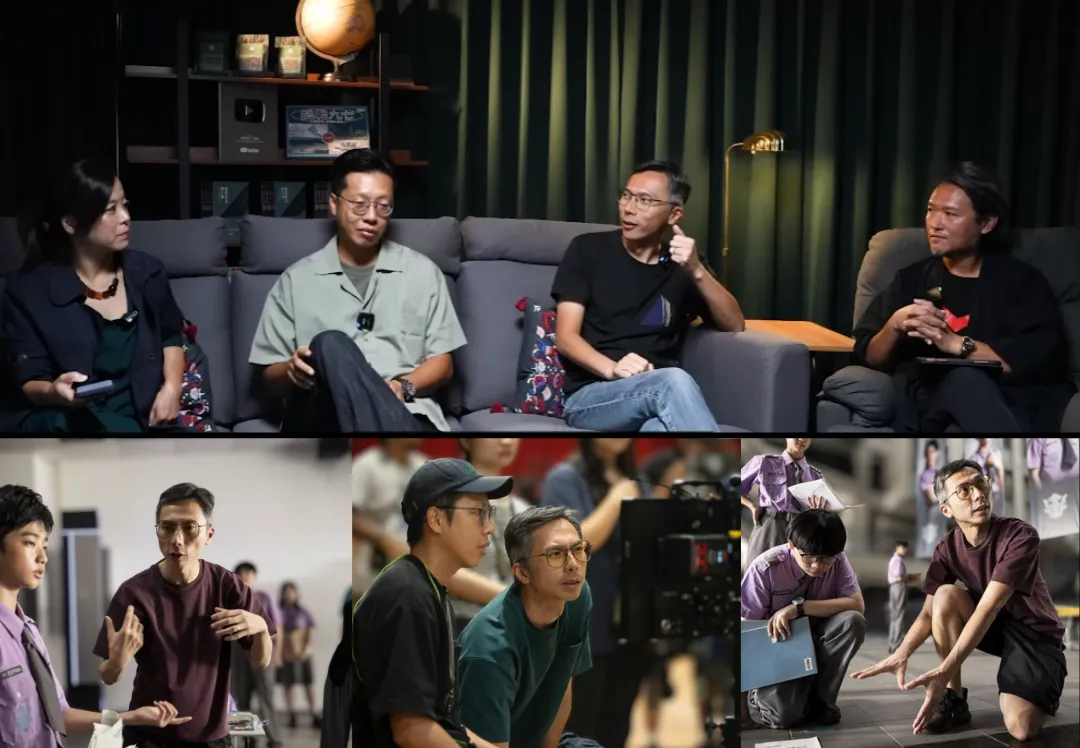
Editorial Note: This interview was conducted by Steven River and Cheuk Nam for the programme "Gau Lai Dei: Talking Cinema," written by the Sinic Analytica editorial team.